
Reading vs audiobooks can sound like a contest with one respectable winner. Yet both are ways of experiencing a book, and the choice often comes down to circumstances: how you prefer to follow language, what access you need, and whether you want to hold a page or let someone else carry the words.
For an evening story, you don't have to prove that the two formats produce identical learning outcomes. Enjoyment isn't an exam. You can choose print for one kind of attention, audio for another, and move between them without being inconsistent. Here's a practical comparison that keeps those differences useful rather than turning them into a hierarchy.
Print and audio give you different kinds of control
On a page, you set the pace continuously. You can pause at a sentence, glance back at a name or reread a paragraph without operating a playback control. The layout can help you locate a passage: a chapter opening, a line near the top of a page, or a conversation you remember seeing. That may suit you when language itself is part of the pleasure.
With audio, the narrator supplies a pace and interpretation. A pause, emphasis or change of voice can make a line land differently from the way you would read it silently. You can still stop and replay, but those actions are mediated by the player. That difference isn't a defect; it can be the reason you want a recording in the first place.
Ask which kind of control would feel easier tonight. If you're tired of making decisions, a narrator's steady movement may be welcome. If you want to linger over each image, a page may feel less restrictive. You needn't decide which medium wins in general to know which one sounds nicer for the next twenty minutes.
Think about the setting you're actually in
Audio can travel with you while you prepare food or fold washing. That convenience also means the story may compete with a task. If you lose the thread while measuring ingredients, it doesn't show that audiobooks don't work for you. It may simply mean the combination asks for more attention than you'd like to give.
Print usually asks for your eyes and somewhere to hold or place the book. That can create a welcome boundary: you sit down and do one thing. It can also be awkward when your hands hurt, lighting is poor or holding the book is uncomfortable. The more useful comparison is between two real setups, not idealised pictures of a reader and a listener.
You might use both at different moments. Read on the sofa while you still want to engage, then choose a familiar audio story when you prefer to close your eyes. Or listen on a walk and keep a paper book for later. There's no obligation to split the evening this way; it's simply permission to choose by context rather than loyalty to a format.
Accessibility isn't a lesser form of reading
For some people, audio isn't a convenience added to an otherwise straightforward choice. It's an important route into books. The US Library of Congress's National Library Service provides audio and braille services for eligible people whose visual, physical, perceptual or reading disabilities prevent them from reading or holding the printed page. That is a reminder to avoid treating listening as a second-class experience.
Needs differ within every broad group. Someone may want audio and text together; someone else may prefer large print, a screen reader or a particular narrator. Hearing differences can also affect whether a recording is useful. Ask about the person's preferences rather than assuming that a format labelled accessible will suit everyone in the same way.
If you're choosing for yourself, notice the friction rather than judging it. Can you adjust the text comfortably? Can you hear the voice clearly without an unpleasant volume? Are the player controls understandable? A book that is technically available can still be difficult to use. Practical access matters more than winning an argument about what counts as proper reading.
Learning and bedtime enjoyment are different questions
Claims that reading and listening are identical for comprehension need context: identical for whom, using what material, with what task afterwards? Learning a technical procedure, revising for an exam and enjoying a familiar novel aren't interchangeable situations. This guide doesn't claim a universal equivalence, nor that one format automatically makes you remember more.
If you need to retain something, choose tools that fit the task. You may want searchable text, notes, bookmarks or the ability to hear a passage repeatedly. Try a small section and see whether you can use the information afterwards. That is a practical approach to your own needs, not a formal experiment or a guarantee about how every reader learns.
At bedtime, remembering everything may not be the aim at all. You might welcome the freedom to let a description pass without collecting it. A story can be worth your time even if you can't summarise every scene the next morning. If you want detailed learning, give it a time and setting where that kind of attention feels appropriate.
Choose what feels comfortable at night
For print, consider the whole arrangement: light, posture, text size and the weight of the book. You don't need an elaborate reading corner, just a setup you aren't constantly adjusting. If you're using a screen, check its brightness and notifications. The question is whether the experience lets you stay with the story, not whether it looks like an ideal bedtime routine.
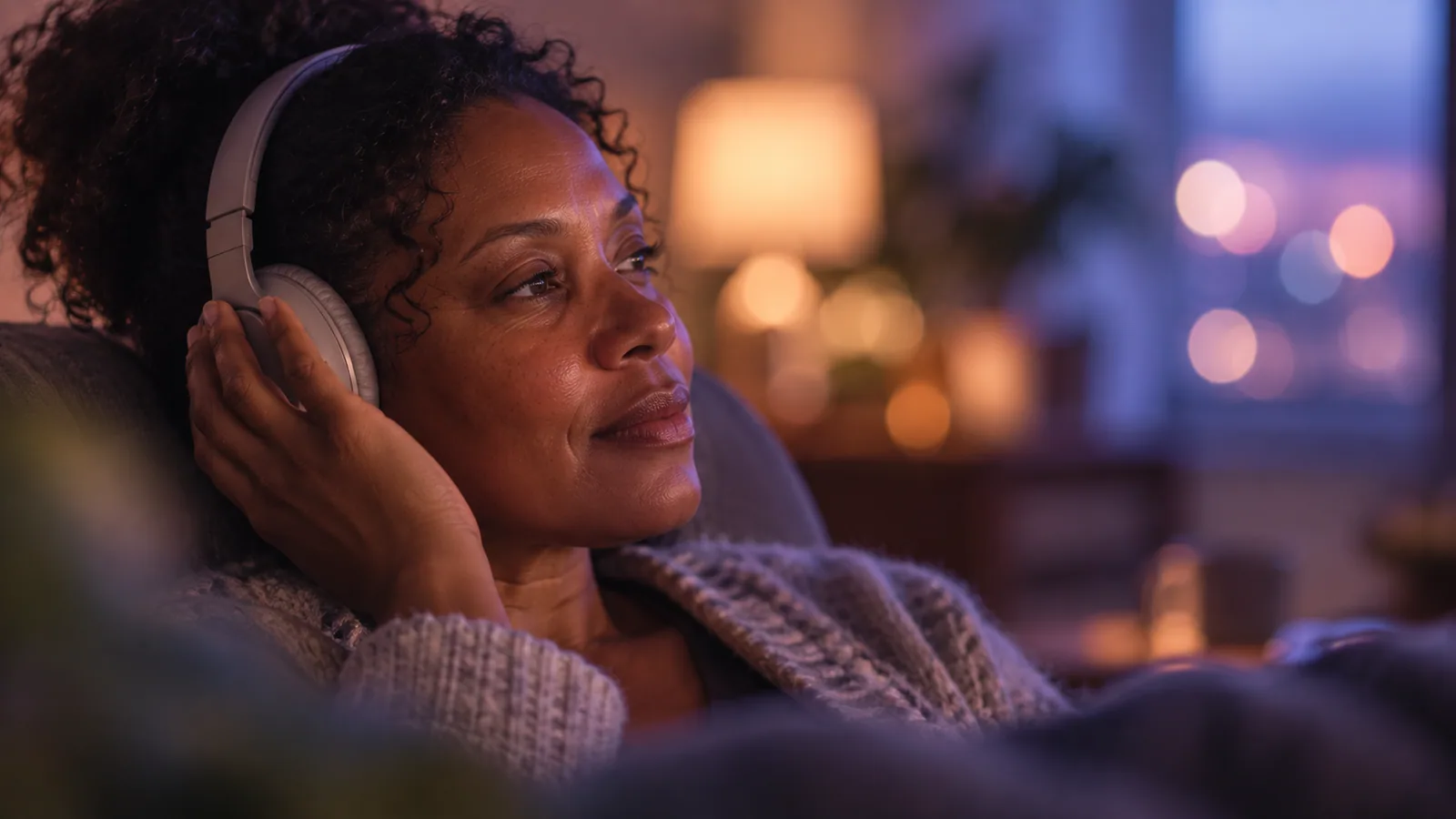
For audio, think about volume and where the sound comes from. Headphones may be useful in a shared space but uncomfortable in your usual sleeping position. A speaker may be easier for you and unwelcome for someone else. Choose together where necessary. No format deserves to make another person's evening harder just because an article calls it calming.
Content matters as well as medium. A cliffhanger on paper can keep you reading; a dramatic recording can keep you listening. If you want something less demanding, choose a familiar passage or a self-contained story. Swapping formats won't necessarily change the emotional pull of the same plot, and you don't have to finish an intense section tonight.
Try a small comparison, not a permanent decision
Choose a story you already know and spend a little time with it in each format on different evenings. Don't score your sleep or force an equal number of minutes. Notice whether you enjoy the narrator, miss the page, prefer having your hands free, or find yourself wanting to stop. Those observations are enough to guide your next choice.
Lumi offers written stories alongside podcast editions, so you can explore the same imaginative world in either form. The Dreaming Gallery is one example. Read a little if you want to linger over its setting, or choose the audio if an eyes-closed journey appeals. Neither version is a health intervention or a test of whether you're good at relaxing.
You may end up with no single answer. Reading can be right on Monday and listening right on Thursday. You can love a book but dislike its recording, or enjoy a narrator more than the printed prose. That's not a failure to choose. It's the ordinary flexibility of finding more than one way into a story.
Sources