Read The Story
Taron’s favorite part of the day was when he found Liam’s latest note, hidden beneath the same gnarled root of the ancient tree at the edge of the forest. The two boys, though worlds apart, had become secret penpals. Each note was filled with the little things they loved—Liam wrote about the way the wind whistled through the trees, how he could hear the birds sing when he woke up in the mornings, and how the warmth of the sun made him feel alive.
Taron, in turn, shared pieces of his own life, though he always had to be careful not to say too much. He described the night sky, the way the stars seemed to pulse with life, and how his world was always warm. He couldn’t mention the real source of that warmth, or that his people lived far beneath the surface, surrounded by the glow of the planet’s core. But the letters gave him something to look forward to—a connection to the surface that he had long yearned for.
As the weeks passed, Taron began to feel a deeper bond with Liam. It wasn’t just the wonder of exchanging letters with someone from the surface, but the way Liam’s carefree life contrasted with his own. Liam’s innocence fascinated him. Taron, though young, had been educated far beyond his years—he had learned the languages of the surface in history lessons at school, where the elders spoke of a time when his people had once lived above ground, before the world was reshaped by catastrophe.
Taron knew the rules. His people had an important law, passed down through generations: never interfere with the natural development of the surface dwellers. Their world was not ready for the Solari’s advanced knowledge. In fact, there had been a time long ago when they had tried to intervene, and the result had been disastrous. Taron had learned all this in school, taught by the elders with their endless wisdom. And yet, despite everything he knew, Taron’s curiosity got the better of him.
It had started with a visit to the observatory. The observatory was a place of quiet, where his people watched the surface through countless invisible viewpoints in the sky—eyes that saw all but were never seen. Taron had sneaked in one evening when no one was around. He had always been fascinated by the surface, by the stories of the world above, where the air wasn’t artificial, and the sun bathed everything in warmth. That’s where he had first seen Liam, running through the forest, carefree and wild.
He couldn’t resist the pull. One night, Taron slipped out and took the forbidden route to the surface. There was no need for guards—his people trusted one another completely, for there was no crime in their world. But Taron’s curiosity was too strong to be stopped by mere rules. He longed to feel the sun on his skin, to breathe air that wasn’t manufactured. That’s when he left the first note for Liam, hidden beneath the tree.
Their secret friendship blossomed from there. Over time, they wrote to each other about their lives, their dreams, and the things they loved most. Taron never revealed too much, always careful to keep his true origins a mystery. He wanted Liam to see him as a friend, not as something strange or otherworldly.
It wasn’t until one of Liam’s letters hinted at something more serious that Taron’s heart sank. Liam had written about feeling unwell, though he brushed it off as if it were nothing. But Taron knew better. He had seen this before—he could recognize the signs of illness even through the words on the page.
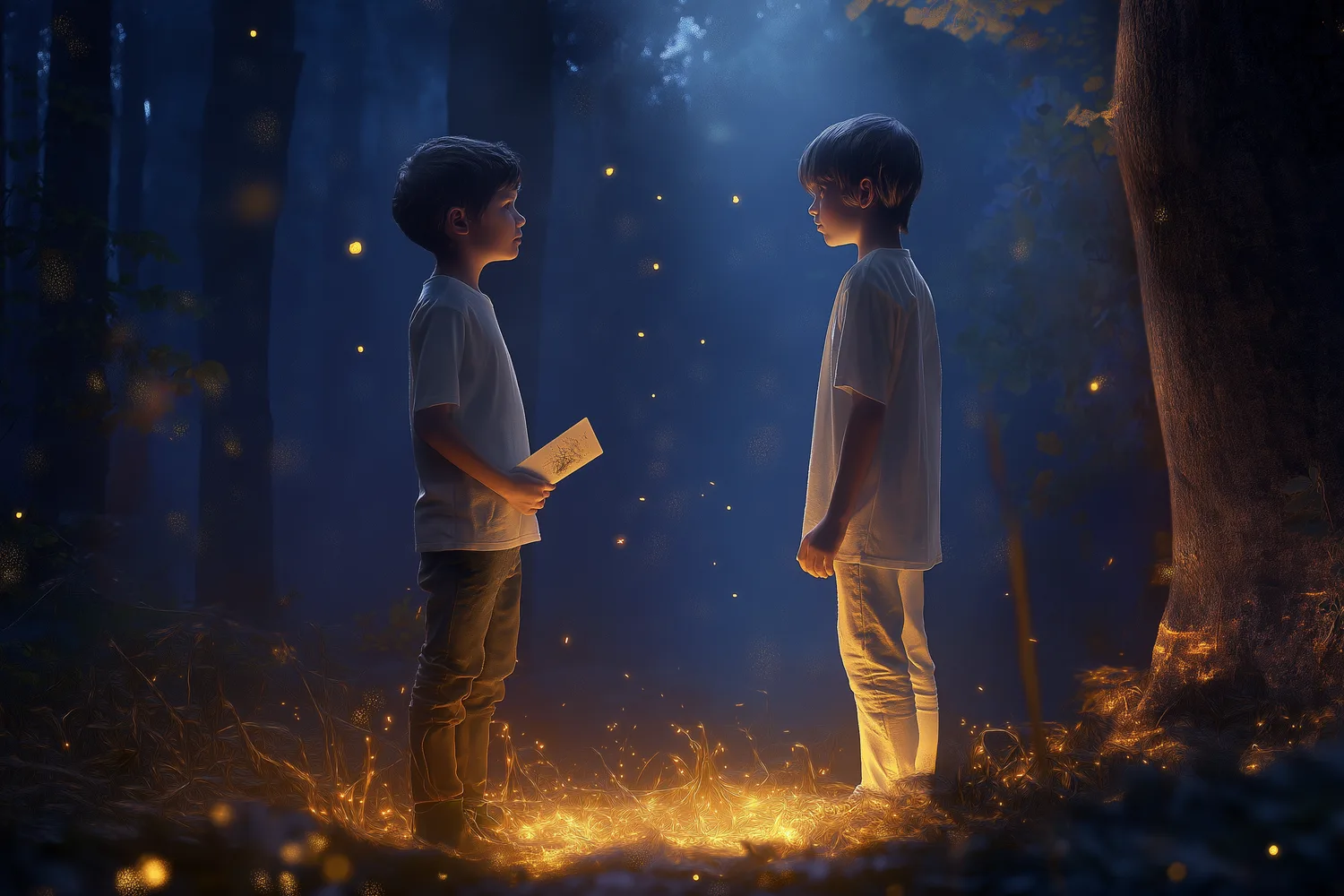
That’s when Taron made the decision to reveal himself. Not just as the boy who had left the notes, but in person. When he stepped from the shadows to meet Liam in the forest, Liam’s eyes lit up with recognition, though he had never seen Taron’s face before. They smiled at each other, and in that moment, their connection deepened beyond the letters they had exchanged.
From that day forward, Taron and Liam continued to meet. They would talk for hours, exploring the edges of the forest together, sharing stories and secrets. But Liam never knew the full truth. Taron couldn’t bear to tell him that each time they met, he was secretly healing him, using a power his people possessed—the ability to absorb pain and suffering through touch.
At first, Taron could manage. His young body, though strong, could take the burden of Liam’s illness. A handshake, a hug—each time, Taron took on a little more of the boy’s pain, easing his symptoms and giving him peace for a while. But as the months passed, the toll grew heavier. Taron’s abilities were underdeveloped, and he could only delay the inevitable.
Lying in his bed one night, Taron felt the weight of Liam’s illness pressing on him. His body trembled, his muscles ached, and the pain made it hard to breathe. But even in his suffering, he took comfort in the thought that Liam was sleeping peacefully, free from pain—at least for now.
Taron knew there was a way to save Liam for good. The technology his people possessed could cure him easily. It was a simple procedure, one that had been perfected over centuries. But to do so, Taron would have to bring Liam into his world—something that had never been done before. It would break the most sacred rule of his people, and he had no idea what the consequences might be.
As he lay there, staring up at the artificial glow of the ceiling above, Taron wrestled with the decision. He had the power to save his friend, but at what cost? Could he really risk everything—the trust of his people, the delicate balance between their worlds—for one boy?
The next morning, Taron stood at the edge of the forest, the sun rising over the horizon. Liam would be waiting for him soon, but Taron’s heart was heavy with the weight of his choice. He had to decide, and once he did, there would be no turning back.
He took a deep breath, knowing that whatever he chose, it would change everything.
Heart of the Story: The Weight of Choices and the Power of Connection
At its core, Taron and Liam’s story explores the delicate balance between personal desires and the greater good. Taron's deep connection with Liam challenges the rules of his hidden society and forces him to weigh his personal feelings against the survival of his people’s way of life. This narrative brings to light the complexity of self-sacrifice—how far are we willing to go for those we care about? And at what cost to ourselves or others?
Taron’s struggle is also a metaphor for the boundaries we set in our relationships. By secretly healing Liam, Taron carries the emotional and physical burden of his friend’s illness, pushing himself to the brink. This reflects a common adult dilemma: how much of ourselves should we give to help those we love, and at what point does that sacrifice become too much? The story asks us to reflect on how, in our own lives, we often shoulder the burdens of others, sometimes at the expense of our own well-being.
It also explores the tension between trust and secrecy. Taron’s choice to keep his true identity hidden is an act of protection, but it comes with the emotional weight of withholding the truth. The story asks: how much of ourselves can we conceal in relationships before it becomes harmful? Taron’s eventual revelation to Liam, though difficult, symbolizes the importance of honesty and the vulnerability it brings.
In the end, the story speaks to the universal challenge of making impossible choices—whether to follow the path laid out by society, or to carve our own, even if it risks everything. It reminds us that in life, some decisions weigh heavier than others, and the impact of those choices can ripple across relationships, communities, and even worlds.
Beyond the Story: Cryptoterrestrials and Hidden Civilizations
In Taron and Liam's tale, we touch on a fascinating and speculative concept—the existence of cryptoterrestrials, a hypothetical race of beings that live alongside humanity but remain hidden. Cryptoterrestrials are often imagined as the survivors of cataclysms that have reshaped the Earth in ancient times. Their societies, far more advanced than our own, are believed to have adapted to living in secrecy beneath the surface or in remote locations.
This idea draws on theories like those put forward by researcher Hal Puthoff, who explored the possibility of ultraterrestrial civilizations in his paper on the subject. These beings, he speculates, could be so advanced that they operate beyond our normal comprehension, using technology and knowledge we can barely begin to understand. Similarly, the book Cryptoterrestrials by Mac Tonnies suggests that these beings might not come from other planets, but from Earth itself, surviving unnoticed while influencing human events in subtle ways.
In the story, Taron’s people, the Solari, could be seen as a form of cryptoterrestrials—an ancient, advanced society choosing to live underground and stay hidden from the surface-dwelling humans, even though their knowledge and technology could drastically change the surface world. They live by strict rules, balancing the need for secrecy with their curiosity about the surface world.
This theme invites readers to ponder deeper questions about humanity’s past and our place in the universe. Could there be hidden civilizations on Earth? And what would be the cost if they revealed themselves to us?